
The Fragility of Modern Democracy — Rethinking Representation in the Digital Age
Democracy has long been celebrated as the pinnacle of political organization, a system designed to balance power, protect rights, and ensure accountability. Yet in the twenty-first century, democracy itself faces a paradox: it is simultaneously more widespread and more fragile than ever before. The very mechanisms that once guaranteed legitimacy are now under strain, challenged by technology, polarization, and the erosion of trust.
ALL NEWSOPINION

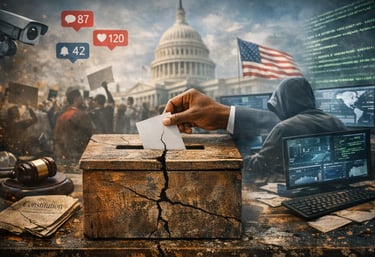
The Fragility of Modern Democracy — Rethinking Representation in the Digital Age
Democracy has long been celebrated as the pinnacle of political organization, a system designed to balance power, protect rights, and ensure accountability. Yet in the twenty-first century, democracy itself faces a paradox: it is simultaneously more widespread and more fragile than ever before. The very mechanisms that once guaranteed legitimacy are now under strain, challenged by technology, polarization, and the erosion of trust.
At its core, democracy depends on representation. Citizens elect leaders to act on their behalf, trusting that institutions will safeguard fairness and transparency. But representation is increasingly distorted. Campaigns are shaped not by dialogue but by algorithms. Political discourse is filtered through social media platforms that reward outrage over reason. The result is a system where perception often outweighs policy, and where legitimacy is measured in clicks rather than consensus.
The fragility of modern democracy lies in its vulnerability to manipulation. Disinformation campaigns, foreign interference, and algorithmic bias have created an environment where truth itself is contested. Citizens no longer share a common narrative; they inhabit fragmented realities curated by digital platforms. Without shared truth, representation collapses into spectacle.
Economic inequality compounds this fragility. Wealth amplifies voice, and those with resources can dominate political discourse through lobbying, media ownership, and digital influence. The promise of equal representation is undermined when access to power is determined by capital rather than citizenship. Democracy becomes less about the will of the people and more about the architecture of influence.
The challenge is not simply to defend democracy but to reinvent it. Representation must evolve beyond periodic elections into continuous accountability. Digital tools can be harnessed to create participatory platforms where citizens engage directly in decision-making. Transparency must be codified into systems, ensuring that data, policy, and governance are accessible and verifiable.
Education is central to this reinvention. Citizens must be equipped not only with knowledge of rights but with the skills to navigate digital ecosystems critically. Without digital literacy, democracy risks being hijacked by manipulation. Empowered citizens are the only safeguard against the erosion of legitimacy.
The path forward requires courage. Leaders must resist the temptation to exploit division for short-term gain. Institutions must adapt to the speed of digital communication without sacrificing integrity. Societies must recognize that democracy is not self-sustaining; it requires constant maintenance, vigilance, and reinvention.
Ultimately, democracy in the digital age will survive only if it redefines representation. It must move from being a system of periodic delegation to one of continuous participation. It must ensure that truth, transparency, and equality are embedded in its architecture. The future of democracy will not be determined by tradition alone—it will be shaped by the ability to adapt, innovate, and protect the essence of representation in a world where perception is power.
— International Affairs NewsPaper™


Summary and Closing
Modern democracy is at a crossroads. Its survival depends on whether societies can transform representation into a system resilient against manipulation, inequality, and fragmentation. The lesson is clear: democracy is not guaranteed by history—it must be reinvented for the digital age. Those who succeed will not only preserve legitimacy but redefine it, ensuring that governance remains rooted in truth, transparency, and the collective will of the people.
→ All News

