
The Architecture of Power and the Collapse of Neutrality
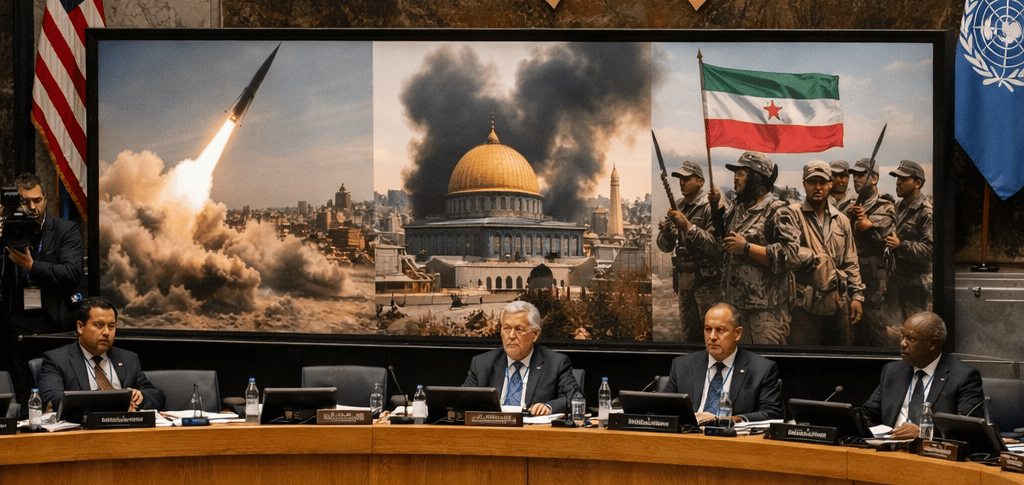
The current geopolitical crisis is not merely a clash of nations—it is a confrontation between two visions of world order. The United States and Israel, armed with technological supremacy and diplomatic leverage, have positioned themselves as architects of “preventive stability,” while Iran and Yemen represent the counter-narrative of resistance against perceived imperial aggression. The United Nations, caught between these poles, has become a spectator to its own irrelevance.
ALL NEWSPOLITICS
The Architecture of Power and the Collapse of Neutrality
The current geopolitical crisis is not merely a clash of nations—it is a confrontation between two visions of world order. The United States and Israel, armed with technological supremacy and diplomatic leverage, have positioned themselves as architects of “preventive stability,” while Iran and Yemen represent the counter-narrative of resistance against perceived imperial aggression. The United Nations, caught between these poles, has become a spectator to its own irrelevance.
UN experts have already denounced the military assaults on Iran and Lebanon as violations of international law, warning that the conflict risks engulfing the region in catastrophic violence. Yet, despite these warnings, the Security Council remains paralyzed—its permanent members divided, its resolutions vetoed, and its credibility eroded. The institution that once symbolized collective conscience now bends under the weight of geopolitical convenience.
The Economics of War and the Diplomacy of Silence
Behind every missile strike lies an economic calculus. War is profitable for those who manufacture it. Defense industries thrive, energy markets fluctuate, and reconstruction contracts await. The United Nations, dependent on the financial contributions of the same powers that wage these wars, finds itself unable to act decisively. Its humanitarian agencies issue statements, its peacekeeping missions remain underfunded, and its moral authority evaporates in the face of realpolitik.
The two-week ceasefire between the United States and Iran, announced after forty days of hostilities, was hailed as progress. Yet, Israeli strikes continued across Lebanon, and civilian casualties mounted. The ceasefire was not peace—it was pause. The UN Secretary-General’s appeal for restraint echoed through diplomatic chambers but failed to reach the battlefield.
The Crisis of Representation
The United Nations was designed to represent humanity, not hegemony. But in practice, it has become a mirror of global inequality. The veto power of five nations—an inheritance from the post-war order—has turned the Security Council into an exclusive club of impunity. When the powerful violate international law, the institution remains silent; when the weak resist, it is condemned.
This imbalance has created a moral vacuum. The UN’s inability to enforce accountability against major powers undermines its foundational principle of equality among nations. The organization’s legitimacy now depends not on its charter but on its courage to confront those who finance its existence.
The Digital Battlefield and the War of Perception
In the twenty-first century, wars are fought not only with weapons but with narratives. Social media platforms amplify propaganda, distort facts, and manufacture consent. The United Nations, slow to adapt to this digital reality, struggles to counter misinformation that shapes public opinion faster than diplomacy can respond. The battle for truth has become as critical as the battle for territory.
Iran and Yemen have mastered the language of resistance, framing their struggle as a fight for sovereignty against Western domination. The United States and Israel, in turn, justify their actions as defense against terrorism and existential threat. Between these narratives, the UN’s voice is drowned in the noise of competing truths.
The Future of Multilateralism
The crisis unfolding today is not the end of the United Nations—it is its test. To survive, the institution must reinvent itself as an architecture of accountability rather than a forum of rhetoric. It must democratize its decision-making, limit the tyranny of veto, and empower regional organizations to act where global paralysis prevails.
Africa, Asia, and Latin America must no longer be spectators in a system designed by others. The Global South must assert its moral and strategic agency, transforming the UN from a Western instrument into a universal platform. The legitimacy of multilateralism will depend on whether it can protect the weak without fear and confront the strong without favor.
Conclusion: The Hour of Reckoning
The United Nations is facing its most profound existential crisis since its creation. The war between the U.S.–Israel axis and the Iran–Yemen coalition is not just a regional conflict—it is a mirror reflecting the collapse of global governance. The institution that was meant to prevent war now documents it; the body that was meant to defend justice now negotiates its price.
If the UN fails to reclaim its independence, it will become a relic of diplomacy—a museum of resolutions without results. But if it dares to confront power with principle, it can still become the conscience of humanity. The choice is not between neutrality and relevance; it is between submission and survival.
In this moment of global fracture, the world does not need another statement—it needs structure. The United Nations must rise not as a witness to history but as its architect. Only then will peace cease to be a pause and become a system.
— International Affairs NewsPaper™


Summary and Closing — United Nations Currently Facing Political Pressure
The United Nations stands today as both symbol and casualty of global imbalance. The war between the U.S.–Israel axis and the Iran–Yemen coalition has revealed the institution’s deepest weakness: its dependence on the very powers it was created to restrain. What was once a moral compass has become a diplomatic echo chamber, where resolutions are drafted under pressure and vetoes replace justice.
This essay concludes that the UN’s crisis is not procedural—it is existential. Its paralysis before open violations of international law exposes a system built on compromise rather than conscience. The organization must evolve from a forum of rhetoric into an architecture of accountability, capable of confronting power without fear and defending peace without permission.
If it fails, the UN will remain a witness to history rather than its architect. But if it dares to reclaim independence, democratize its structure, and empower the Global South, it can still become the conscience of humanity. The choice before it is stark: submission or survival. In this century of fragmentation, neutrality is no longer virtue—it is abdication.
→ All News

