
Institutional Decline and Political Reinvention
Across multiple regions of the world, political institutions are facing a growing crisis of legitimacy. Structures that once provided stability, continuity, and public trust are increasingly perceived as inefficient, disconnected, or incapable of responding to contemporary challenges. This erosion is not always sudden or visible; more often, it is gradual, accumulating over time until it becomes structurally significant.
ALL NEWSPOLITICS
Institutional Decline and Political Reinvention
Across multiple regions of the world, political institutions are facing a growing crisis of legitimacy. Structures that once provided stability, continuity, and public trust are increasingly perceived as inefficient, disconnected, or incapable of responding to contemporary challenges. This erosion is not always sudden or visible; more often, it is gradual, accumulating over time until it becomes structurally significant.
Institutional decline rarely begins at the surface. It is typically rooted in a widening gap between formal systems and operational reality. Laws, procedures, and frameworks may remain intact, but their effectiveness diminishes as they fail to adapt to changing economic, technological, and social conditions. Over time, this creates a perception—and often a reality—of stagnation.
One of the primary drivers of this decline is complexity. Modern societies operate within highly interconnected systems where decisions in one domain have cascading effects across others. Traditional institutional models, designed for more linear and predictable environments, struggle to manage this level of interdependence. As a result, responses become slower, less coordinated, and often reactive rather than strategic.
Public expectation has also evolved. Citizens today are more informed, more connected, and less willing to accept inefficiency or opacity. Digital communication has amplified this shift, making institutional shortcomings more visible and more immediate. Trust, once assumed, must now be continuously earned and demonstrated.
At the same time, political systems are increasingly influenced by short-term pressures. Electoral cycles, media dynamics, and immediate public reactions often take precedence over long-term planning. This creates a structural imbalance, where institutions prioritize survival over transformation. The consequence is a cycle of incremental adjustments rather than meaningful reform.
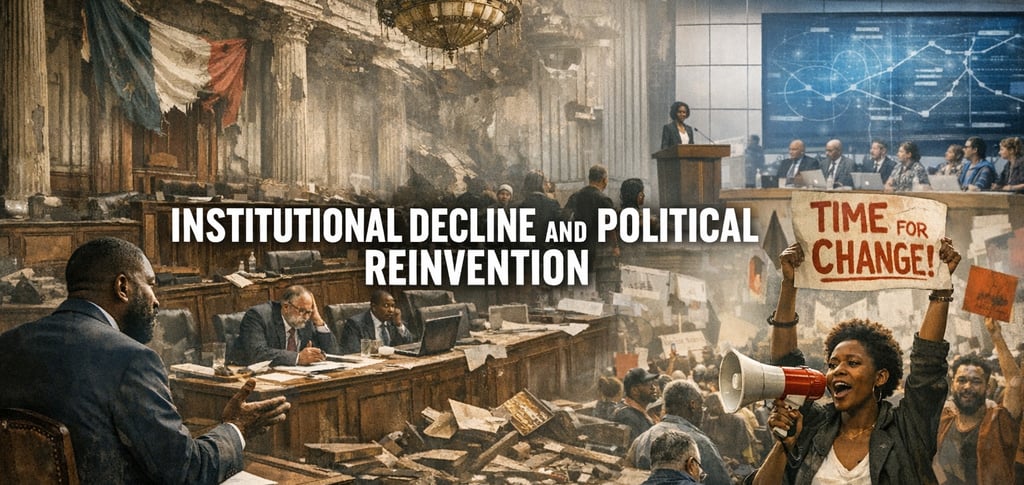
However, institutional decline does not necessarily lead to collapse. In many cases, it creates the conditions for reinvention. Moments of systemic stress can act as catalysts, forcing a reevaluation of existing models and opening space for innovation. The key question is not whether change will occur, but how it will be managed.
Political reinvention can take multiple forms. It may involve the modernization of existing institutions through digital integration, improved transparency, and more efficient processes. It can also include the creation of entirely new structures designed to operate within contemporary realities. In both cases, the objective is the same: to restore functionality, credibility, and relevance.
Leadership plays a critical role in this process. Reinvention requires not only technical solutions but also strategic vision. It demands the ability to move beyond established patterns, to challenge entrenched interests, and to implement changes that may be disruptive in the short term but beneficial in the long term. This is inherently complex and often contested.
Another important dimension is the role of non-state actors. Civil society, private sector entities, and independent platforms are increasingly filling gaps left by traditional institutions. While this can enhance flexibility and innovation, it also raises questions about coordination, accountability, and the balance of power.
Technology, once again, is a double-edged factor. It offers tools for efficiency, participation, and transparency, but it also introduces new vulnerabilities and complexities. The integration of digital systems into governance must therefore be carefully managed to ensure that it strengthens rather than undermines institutional integrity.
Ultimately, the future of political systems will depend on their capacity to evolve. Institutional decline is not an endpoint; it is a signal. A signal that existing models are no longer sufficient, and that new approaches are required. Whether this leads to fragmentation or renewal will depend on the choices made by leaders, institutions, and societies as a whole.
In a world defined by rapid change, resilience is no longer about maintaining the status quo. It is about the ability to adapt, to innovate, and to rebuild. Political reinvention is not optional—it is a structural necessity for any system that seeks to remain relevant and effective.
— International Affairs NewsPaper™


Summary and Closing
Institutional decline is not merely a symptom of failure—it is a catalyst for transformation. As traditional systems lose relevance, new frameworks of governance are emerging, driven by innovation, civic engagement, and digital integration. Africa, like many regions, stands at the forefront of this reinvention, where resilience is defined not by preservation but by adaptation. The future of political legitimacy will belong to those who can rebuild trust through transparency, efficiency, and vision—turning decline into the foundation of renewal.
→ All News

